UIUC Computer Science · Alibaba Accio
Yuchen (Ean) Wang
I work on agentic post-training and the systems that make it practical.
I am an M.S. student in Computer Science at the University of Illinois Urbana-Champaign and a research intern with Alibaba's Accio team. Previously, I studied artificial intelligence at Peking University in the Zhi Class.
My work spans long-horizon tool use, reinforcement learning, and efficient training and inference. I also study how to schedule and accelerate video generation.
Selected research
All projects

Occamy-1.0: Open Pareto-frontier 35B Intelligence for Co-work
Core contributor to Occamy-1.0 across agentic post-training algorithms, training infrastructure, and data: staged SFT/HDPO, model soup and SAO, compaction-aware credit assignment, execution-grounded data synthesis, and multi-harness asynchronous training.
The released model scores 82.2 on Claw-Eval and 27.6% on AutomationBench, up from 69.5 and 7.5% for the base model.
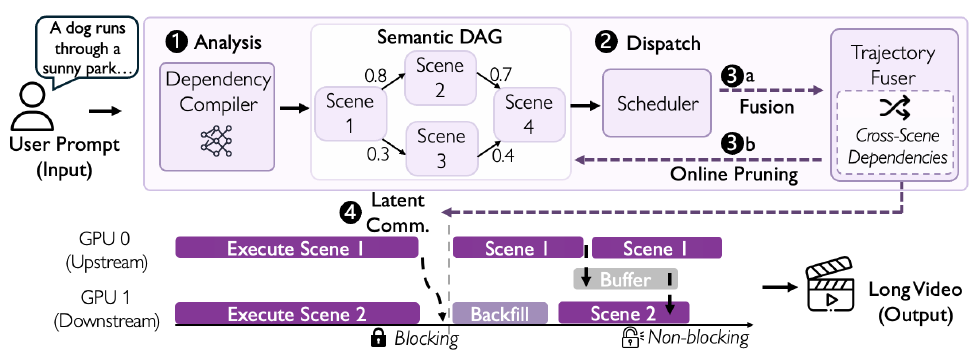
CineFlow: Parallel Video Generation through Semantic Dependency Scheduling
Dependency-aware video generation using semantic DAGs, runtime trajectory fusion, and critical-path scheduling—without retraining the underlying models.
1.7–5.5× end-to-end speedup and 5.4–17.3% higher VBench overall across three video models on 8×H100.
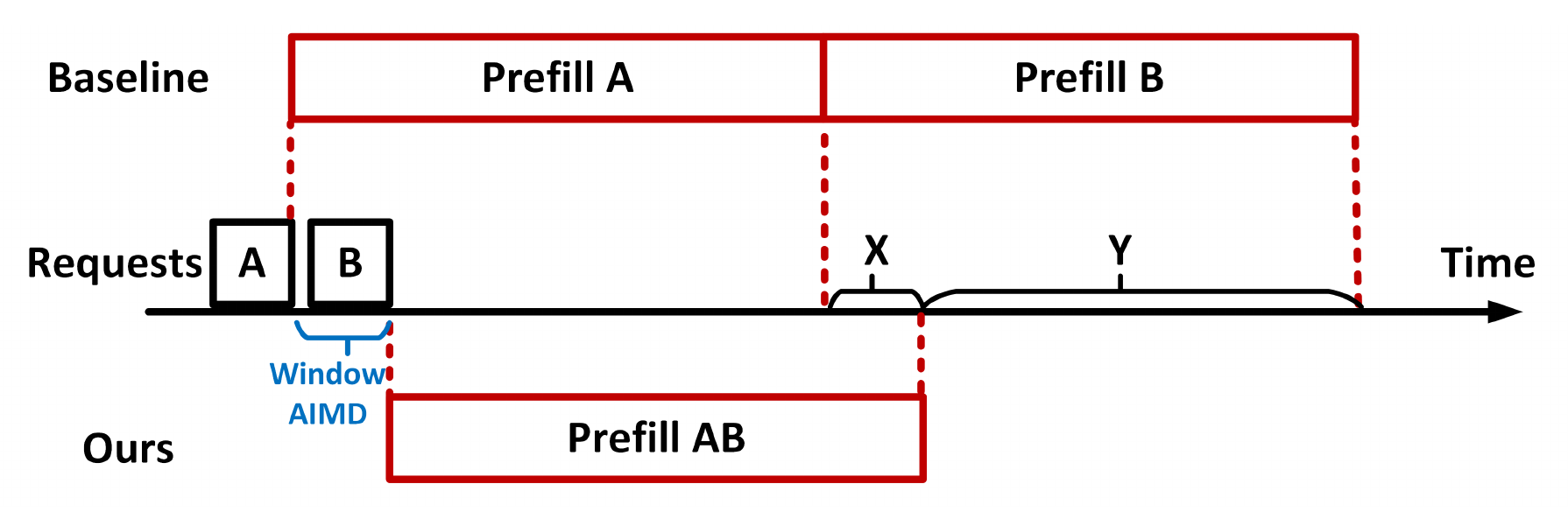
Dynamic Prefill Optimization via Adaptive Online Packing
An AIMD controller uses live p95 time-to-first-token feedback to guide length-aware prompt packing before continuous batching.
Up to 20% lower TTFT on production-style DynamoLLM traces.
Open-source engineering
All contributionsSelected work on training data, numerical correctness, GPU memory, and runtime reliability.
Halved peak memory during BF16 MoE weight conversion.
- #54699 Merged
Implementation notes
In-place FlashInfer conversion reduced peak allocation from 7.88 to 3.94 GiB in the TP2 measurement, avoiding a second full set of converted weights.
Restored worker parallelism in shuffled streaming datasets.
- #8670 Merged
Implementation notes
Preserved source shards through interleaving so four DataLoader workers can use 19 shards, with deterministic epoch and checkpoint regression coverage.
Improved packed QSA selection and low-precision training behavior.
Implementation notes
Scoring QSA blocks within each document was 2.70× faster in an 8K synthetic selector case. Follow-up PRs preserve BF16/FP16 gate rounding and bound PLE backward's extra workspace; full-model gains are not claimed.
Reduced teacher-payload transfer overhead for distillation.
- #3943 In progress
Implementation notes
Deferred top-k teacher payloads across Ray workers, with a 4.44–5.31× speedup in controlled transfer measurements—not an end-to-end training speedup.
Building Bridge-local Qwen4-Exp text-decoder support.
- #6315 In progress
Implementation notes
Covers QSA, per-layer embeddings, gated residuals, and HF conversion. CPU unit checks passed; GPU integration and end-to-end training parity remain pending.
Corrected K/V calibration scales in ragged FP8 prefill.
- #4984 Merged
Implementation notes
Applied calibration scales in the ragged prefill path so FP8 key/value tensors retain the intended numerical interpretation.
Fused GatedDeltaNet normalization; added selective Mamba recompute.
Implementation notes
Folded Q/K L2 normalization into the gated-delta kernel and added a selective recompute option for Mamba blocks.
Made Muon normalization scale-invariant for small-norm inputs.
- #230 Merged
Implementation notes
Fixed the Newton–Schulz normalization path to preserve scale invariance when input norms are small.
Improved tool-schema handling and SSH reconnect reliability.
Implementation notes
Resolved local schema references during tool-argument coercion and waited for pooled SSH teardown before reconnecting.
PR status snapshot: . Live discussion on GitHub.
Academic service
Reviewer, WSDM 2027.
